A Note Before Reading
I know many teachers have already heard too many discussions about “AI,” and may even feel tired of the topic. But I still believe it deserves repeated, serious reflection. More importantly, every careful discussion does not weaken our value as human beings. On the contrary, it helps us see more clearly what we can do, why we should do it, and how we might do it.
First, I want us to think together: when facing AI, are we choosing to embrace it or reject it? Many people see this as a choice, but in reality, we may already be inside it and unable to stand outside. Second, when everyone is talking about how AI will change education, I am more interested in asking: what exactly has changed? And what role do frontline teachers play within it?
I call this piece The Ten-Year Countdown: What Can I Do? for two reasons. On the one hand, before we begin practicing hands-on, I hope we can first slow down and think about these questions. On the other hand, even after we become skilled at using AI, I hope we can return to these reflections. It is both a beginning and a point we can keep revisiting.
1. Why a ten-year countdown?
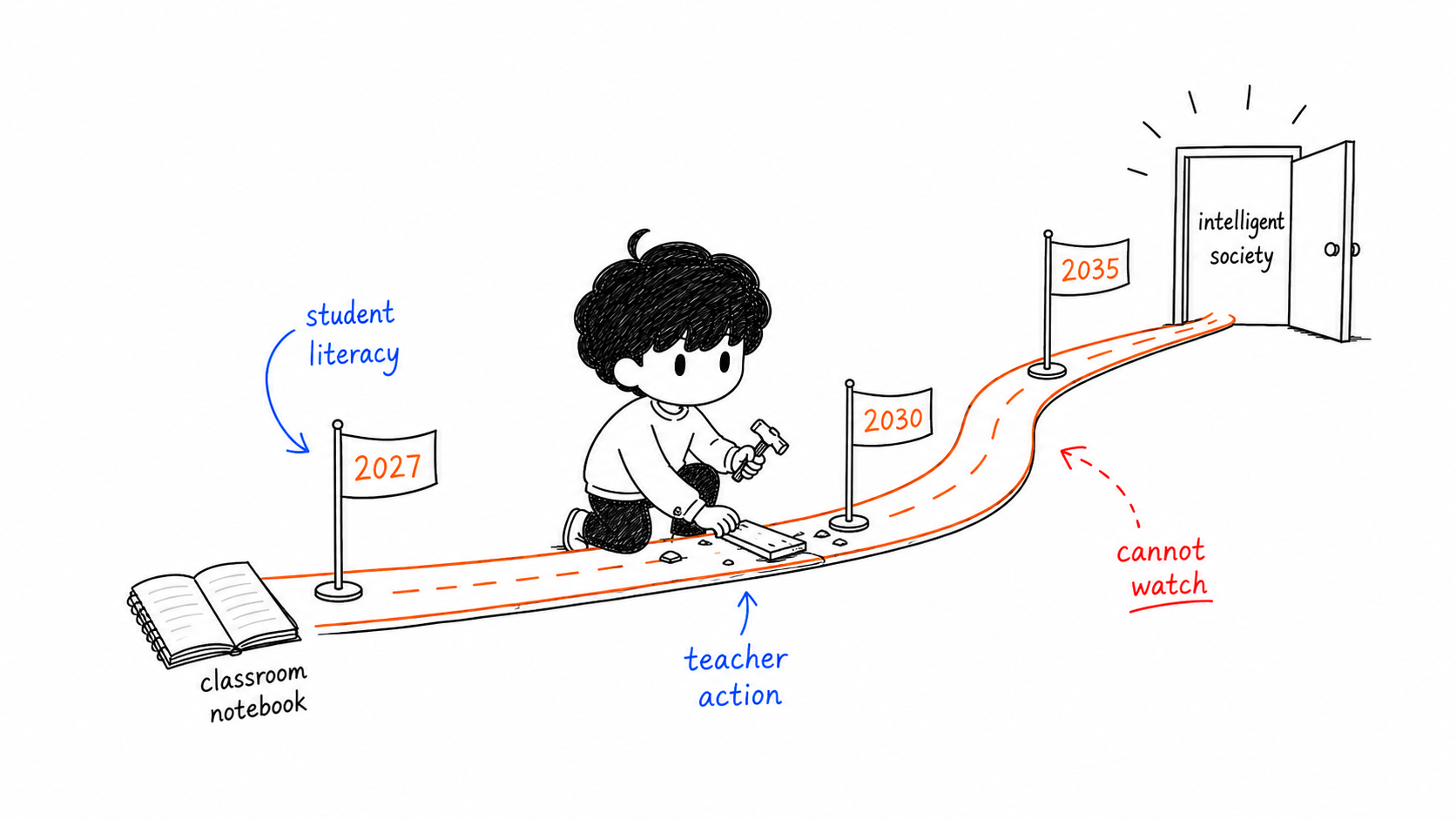
China’s “AI Plus” implementation plan (人工智能+) gives us a clear timeline: by 2027, next-generation intelligent terminals and agents should exceed 70% penetration; by 2030, they should exceed 90%; and by 2035, we will fully enter an intelligent economy and intelligent society.
The word “fully” suggests a deep and thorough change. That day is only ten years away.
Let us do a simple calculation: ten years from now, students who are about to enter sixth grade will have just graduated from university. At that time, they will face a world deeply integrated with AI. What will that world look like? We cannot fully imagine it yet, but we can be certain that it will be very different from today.
So this is not a simple multiple-choice question. There are not two options called “embrace” and “reject.” The real question is whether we can keep up with the pace of this era. Behind that question is a more practical challenge: what should we do? Does every teacher need to return to school and learn machine learning and deep learning from scratch?
Of course not. This leads to a key concept: literacy.
Think back to the emergence of the internet and smartphones. No one required every person to become a chip expert or software engineer. But the spread of these technologies quietly created a kind of sorting: it separated people with information literacy from those without it. Some people could judge whether information was true or false, while others were easily misled by fake news. Some people could use smart devices reasonably, while others fell into short-video addiction.
The AI age is similar, and the challenge is even greater. Therefore, helping students become people with solid AI literacy, able to face the world they will enter ten years from now, has become a core question that all teachers and parents need to consider.
2. What is AI literacy?
Every teacher is familiar with the idea of “learning objectives.” We carefully design each lesson, unit, and semester by asking what cognitive level we hope students will reach: remembering, understanding, applying, analyzing, evaluating, or creating. This is Bloom’s taxonomy, well known in educational psychology. For a long time, we have understood mechanical memory and surface-level understanding as foundational, while creation has been seen as the highest level of learning.
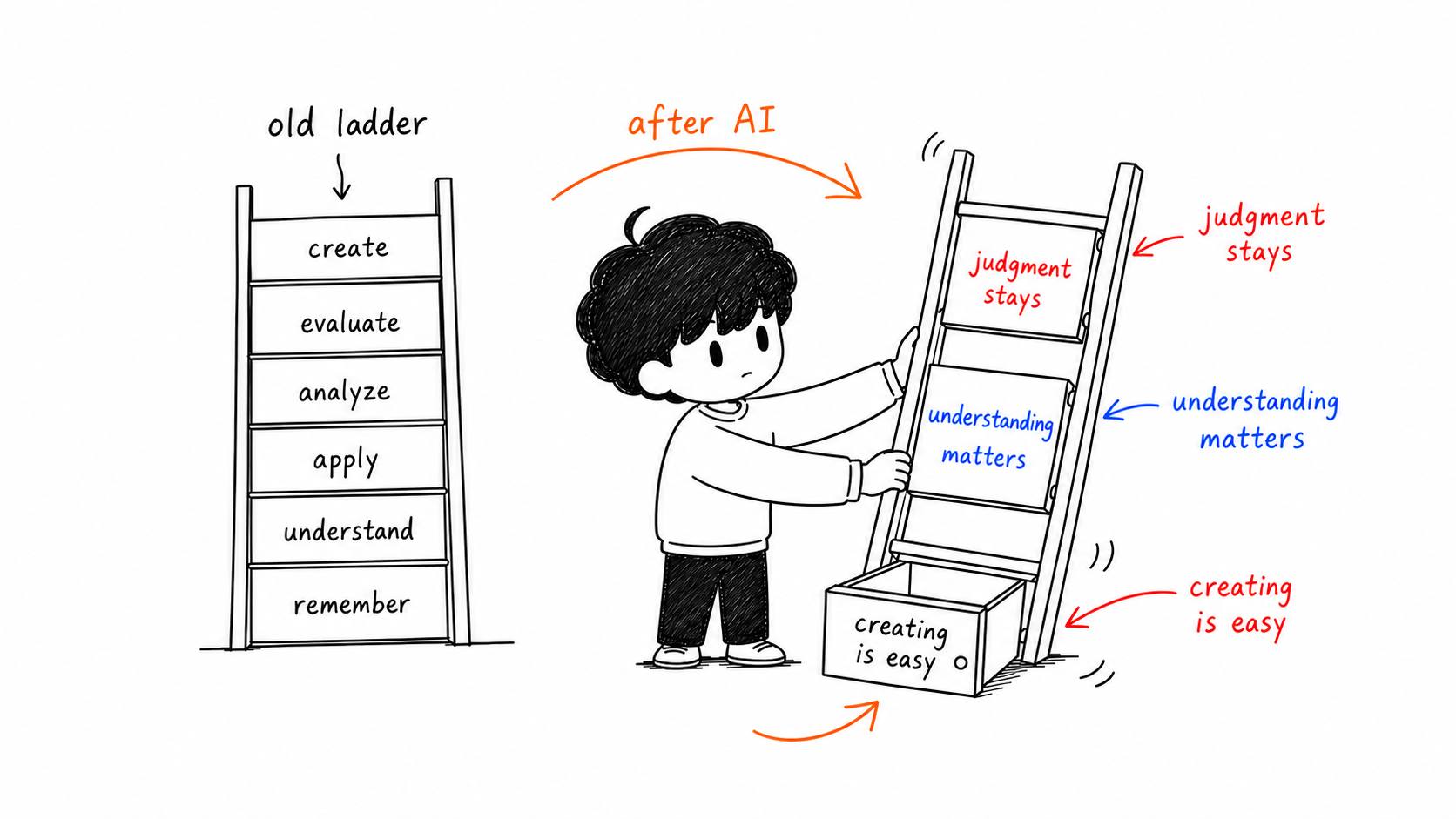
But in the AI age, this cognitive pyramid seems to have been inverted. “Creation” suddenly becomes within reach:
“ChatGPT, help me create a lesson plan for Unit 1, ‘Friendship,’ in seventh-grade English.”
“Doubao (豆包), help me write an 800-word English drama reading response to Aladdin.”
Within seconds, a piece of “creation” that looks quite decent is finished.
When we have to re-examine this classic cognitive pyramid, one interesting discovery is that “understanding” becomes the most challenging part. Do students truly understand how AI works? Do they understand what a large language model is? Do they understand why AI makes mistakes, and what those mistakes mean? These deeper forms of understanding are exactly where most people struggle. This kind of understanding is the core of what we call AI literacy.
Let me clarify one point: AI literacy is definitely not just knowing how to use a new piece of software. Tools emerge endlessly; new AI applications appear every day. Even someone like me, who works in educational technology, cannot try every tool. Real AI literacy means understanding underlying logic and principles. It means being able to quickly learn any new tool while maintaining critical thinking. It keeps you from being dazzled by the surface of technology and helps you see the essence, then make wise judgments and choices.
3. I am not an information technology teacher. Is this related to me?
In real school settings, I have observed a common but debatable phenomenon: many teachers think “AI” belongs to IT teachers or technology integration specialists, and that AI literacy training should be handled by those teachers. I understand where this thought comes from. But I must say that AI education is not only the work of IT teachers. It requires the participation of teachers in every subject.
Why? Because AI is changing not only technology itself, but also the ways knowledge is produced, circulated, and applied. Chinese language teachers need to think about what reading and writing mean in the AI age. Mathematics teachers need to explore how to cultivate logical thinking with AI support. English teachers need to redefine the goals and pathways of language learning. Every subject is undergoing a deep transformation.
More importantly, the ten-year countdown is not only a countdown for students. It is also a countdown for teachers. As teachers, we need to honestly ask ourselves: am I ready? Am I ready to face the world ten years from now, when AI is fully integrated into society? If this question makes you feel even slightly uncertain, the answer is already clear: you need to participate in this transformation, not as an observer, but as an active learner and practitioner.
At the end of 2025, the Ministry of Education released Guidelines for Teachers’ Use of Generative AI, First Edition (《教师生成式人工智能应用指引(第一版)》). The release of this document can be seen as the first milestone in this ten-year journey. It is not the destination, but the starting point, reminding us that this educational transformation has officially begun.
Of course, using AI to generate a lesson plan, create advisory slides, or produce exercises is a good beginning. But is that enough? Clearly not. We need deeper thinking, more systematic learning, and braver practice.
Starting now, learn AI through this website with me, and let us move together toward the world ten years from now. Not by passively waiting for the future to arrive, but by actively creating the educational future we want. The path may not be smooth, but I believe that if we walk together, we can build a road for our students toward the intelligent age.