Continuing from the previous article
The previous article summarized the core content of three documents. Their positions are clear, their wording is standardized, and their data is solid. After reading them, we might feel relieved: there is international consensus, national regulation, empirical data, and everything seems arranged.
But if, like me, you are a frontline teacher in an innovative school, you may find that the more orderly these documents sound, the more tangled daily work feels.
In this article, I want to talk about that tension.
1. What the documents do not quite say: is “leadership” an attitude, or a workload?
The most frequent word across the three documents is “lead.”
Teachers must lead key educational moments, according to China’s Teacher Application Guidelines (《教师生成式人工智能应用指引(第一版)》). Teachers must maintain human accountability, according to UNESCO’s AI Competency Framework for Teachers (《教师人工智能能力框架》). Teachers must be irreplaceable in value guidance, according to the Teacher GAI Report (《2026 中国教师生成式人工智能应用报告》).
All of this sounds right. But think carefully:
Is “leadership” an attitude, or is it a workload?
If it is an attitude, most of us are already leading. The report says 86% of teachers worry that students will lose independent thinking because of AI, and 57% worry that teacher-student emotional connection will be weakened. That alertness itself is leadership.
If it is a workload, that is another matter.
The Guidelines require teachers to review every AI-generated teaching design and every comment; to correct errors, outdated information, or logical bias; to submit sensitive ideological content for school review; and to de-identify data. These are not ideals. They are actual work steps.
The twenty minutes AI saves you in one stage may be returned to you in the review stage, or even cost more.
This is especially important for international and innovation-oriented schools: our teachers’ work density is already high. PBL, interdisciplinary learning, differentiation, parent meetings, extracurricular guidance, subject team work… every item requires thought. AI appears to reduce workload, but if it also adds a quality review procedure that is not counted as workload, then “leadership” becomes invisible labor. You did it, but no one sees it.
2. A risk more hidden than “tool misuse”: cognitive proxy
The report repeatedly mentions the risk of teachers over-relying on AI, but this is often understood as a tool-use problem: copying AI-generated content, or sending it to students without checking.
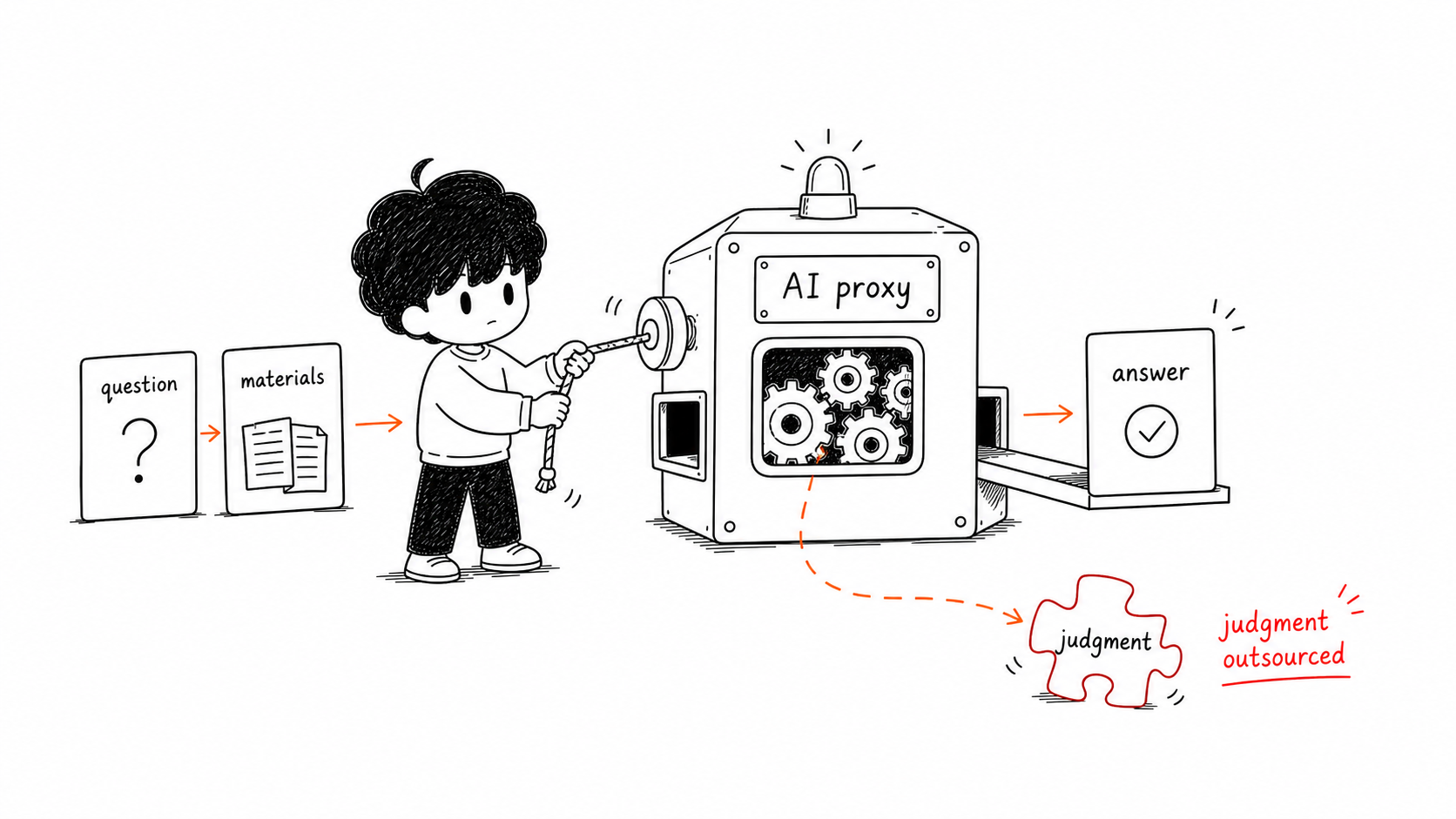
But there is a more hidden kind of dependence that deserves a name: cognitive proxy. It means handing part or all of your professional judgment to an algorithm.
It is not the same as “using AI.” If a teacher asks AI to generate vocabulary exercises, then selects, deletes, revises, and decides how to use them, that is tool use.
But if a teacher asks AI to generate “feedback for this student,” glances at it, thinks “close enough,” and sends it to the student, then the judgment of whether that feedback is appropriate has already been proxied out. Even if the teacher presses send at the end, the person who truly made the professional judgment was not the teacher.
Teachers in international and innovation-oriented schools are especially likely to fall into this proxy for three reasons:
- First, teachers here are generally willing to try new tools and accept them quickly.
- Second, teaching expectations are high and the pace is fast; AI can look like the only way to keep going.
- Third, these teachers often write English fluently and produce strong prompts. AI output can look very professional, professional enough to tempt direct use.
When these three things overlap, they produce a counterintuitive result:
The more skillfully a teacher uses AI, the more easily they may hand over judgment without noticing.
This is exactly what UNESCO’s human accountability principle warns about. But in international schools, it happens in a more hidden way than in public systems, because it is wrapped in the language of “professionalism,” “efficiency,” and “innovation.”
3. A counterintuitive result: the average level of teaching artifacts rises, while variance falls
Let us go one layer deeper.
Usually, we think: if AI is used well, teaching quality improves.
But if “used well” means “AI does more things for me,” then a counterintuitive result waits:
The average level of teaching artifacts rises, but variance falls.
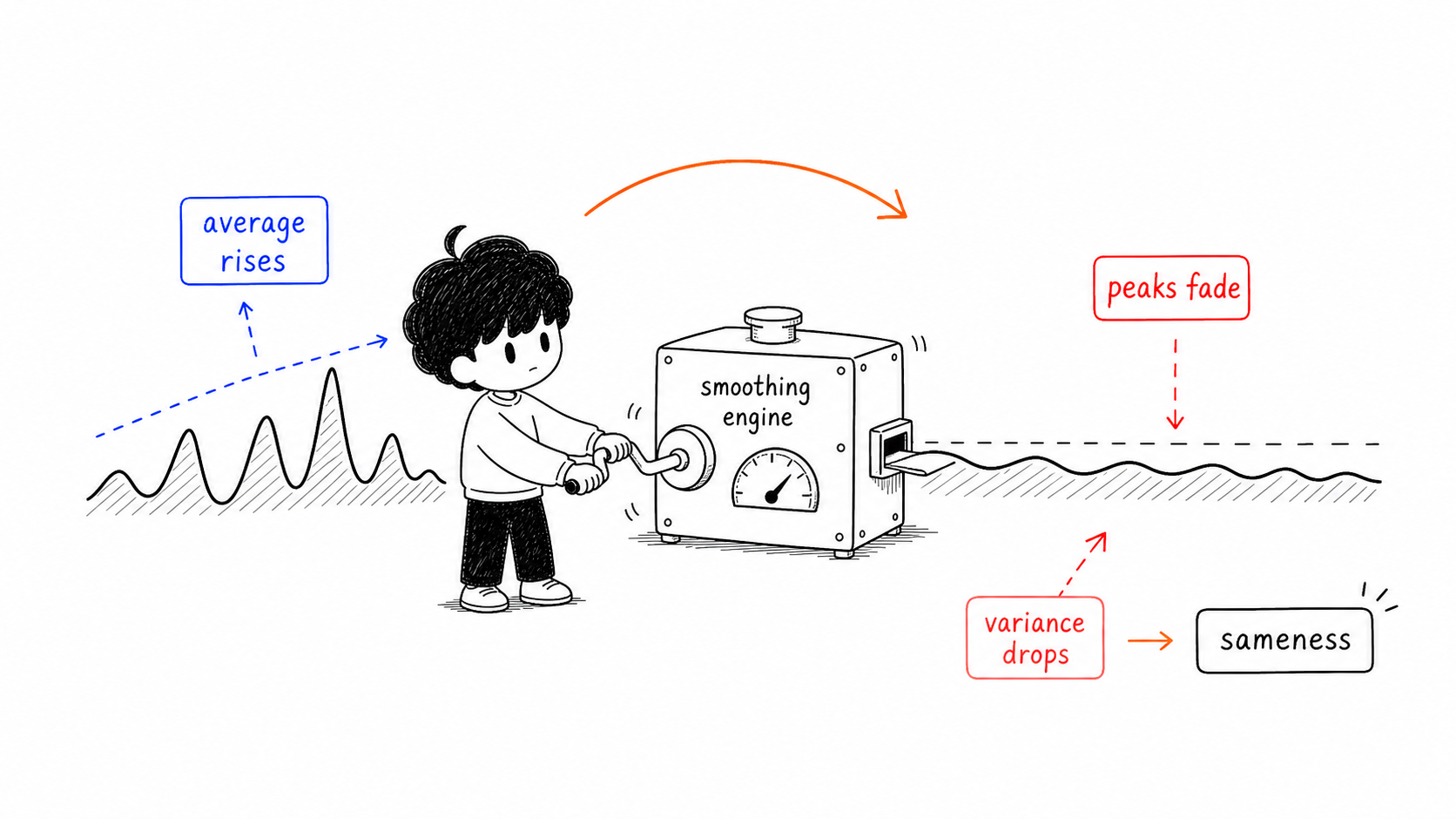
What does this mean? No teacher’s lesson plan will be truly bad anymore. AI does not make grammar mistakes, does not forget learning objectives, and does not omit formative assessment. This is good.
But at the same time, the parts that belong to a particular teacher’s unique intuition disappear: their special understanding of one student, their private entry point into a text, their imagined responses of “if students say this, I will respond this way.” These do not appear in AI output because AI does not know them. If teachers do not add them back, those parts disappear.
At our school, one class has 280 English lessons per academic year. If every lesson is 70% AI-drafted and 30% teacher-adjusted, then across a semester, the students have experienced a kind of algorithmically averaged English education.
The report’s statistic that 86% of teachers worry students may lose independent thinking also applies back to teachers themselves. People just do not want to admit it.
4. How good schools should use UNESCO’s three-level model
The previous article summarized UNESCO’s Acquire / Deepen / Create model. For teachers in innovation-oriented schools, the Acquire stage is already behind us. The problem is that many of us are stuck in the first half of Deepen: integrating AI into existing teaching workflows so that it helps within existing frameworks.
The key to moving toward Create is not writing more complex prompts or using more models. It is something else:
Can we make AI do something it originally could not do: something that only emerges because of you as this teacher, with these students, in this course context?
Here is a concrete example.
An English teacher is teaching a short story about identity.
Deepen-stage use: ask AI to generate discussion questions, reading exercises, and writing prompts. These are all useful.
Create-stage use: the English teacher notices that three students in the class have repeatedly written about the feeling of “not belong to,” even though they do not usually know each other well. Instead of asking AI to revise the drafts or generate comments directly, the teacher uses AI as several kinds of “reader”: one like a peer, one focused on language details, and one that keeps asking, “Why do you think this way?” The three students first read these different reader responses to their drafts, then say which feedback made them feel understood and which parts they want to push back on. The teacher observes and records these reactions, then brings them into later one-on-one conversations.
No AI teaching manual would tell you exactly how to design that process. It requires this teacher’s concrete knowledge of these three students, her own understanding of the text, and her judgment about when AI should step back and when a human should be present.
Create is not a more advanced application. It is a more specific application. The more specific it is, the less replaceable it becomes.
5. Several rules in the Application Guidelines that deserve attention
Many colleagues in international schools may feel that the Ministry of Education’s Application Guidelines are “for public schools.” But several parts fit our system very closely.
On student use: click to expand
The Guidelines clearly prohibit students from directly submitting AI-generated assignments, and require process materials and citation marking.
Students in international schools often have stronger English prompting ability than peers in the public system. This means AI-written work is harder to distinguish from their own writing. If the school does not have clear local rules, teachers fall into a draining state: every time they grade a piece of writing, they must first internally judge “was this written by AI?” before giving real feedback.
So far, there is no reliable tool for this judgment. It still depends on experience. It continuously consumes teachers’ cognitive bandwidth, can damage trust between teacher and student, and is seen by no one.
The solution is not on an individual teacher. It is at the school level. A clear student use policy is more important than introducing any AI tool.
On teacher review: click to expand
The Guidelines require that AI-generated teaching designs or comments must not be used directly without review; sensitive ideological content must be submitted to school administrators for review.
In an international context, this has a special version: sensitivity may not only appear in political topics, but also in cultural topics: race, gender, religion, and historical narratives. AI, especially English-language models, carries its own tendencies on these issues. If teachers use output directly without reading carefully, they may unknowingly bring a specific Anglo-American mainstream narrative into a classroom with students from different national backgrounds.
This is not only a political issue. It is a professional teaching issue.
6. A “what I will not give to AI” list matters more than any AI training
If all of the above feels too abstract, here is something you can do immediately: write your own list of what you will not hand over to AI.
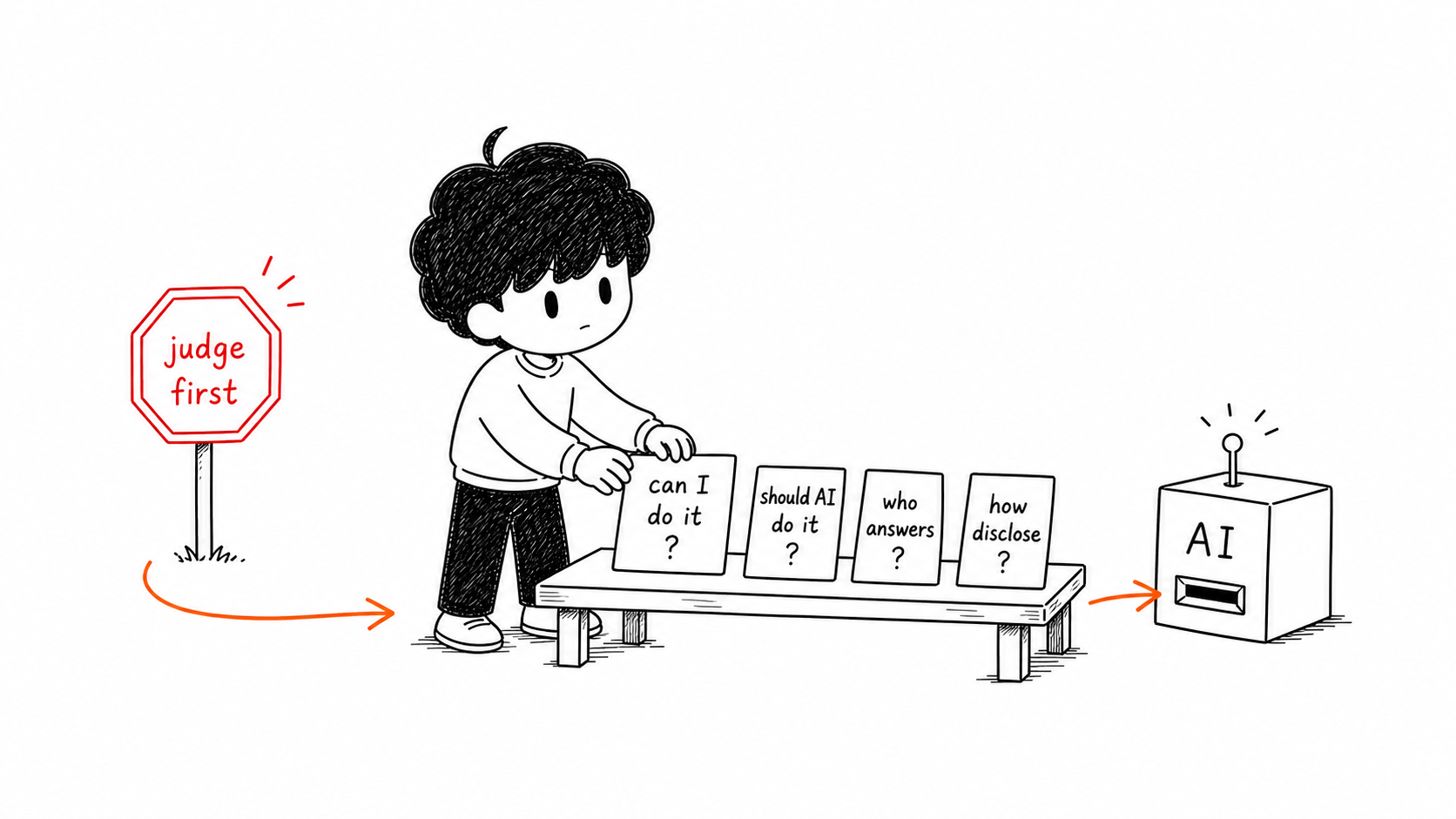
Every time you are about to use an AI output directly in class, ask yourself four questions:
- First, is there any sentence in this output that I would have written differently if AI had not written it? If not, this output has nothing to do with me as a teacher.
- Second, is this output aimed at a specific student, or at an abstract “student”? If it is the latter, I should at least add one sentence for one specific student.
- Third, is there any judgment in this output that I did not personally make, but that will be issued in my name? Do I truly agree with that judgment?
- Fourth, if a student asks, “Teacher, why did you give me this feedback?” can I give a reason that does not depend on “AI suggested it”?
If you cannot answer any one of these four questions, stop and rewrite.
7. Finally, about “irreplaceability”
Across the three documents, everyone agrees on one thing: teachers are irreplaceable in value guidance, emotional resonance, and responding to uncertainty.
This sentence sounds comforting, but it is also dangerous.
Because if we only say “irreplaceable” while handing daily lesson preparation, feedback, assessment, and communication, which are most of what education actually consists of, to AI, then “irreplaceability” becomes a leftover. It becomes the small part of teacher work that AI cannot yet do, the part left behind by the algorithm.
That is not the kind of “leadership” we want.
Real leadership works the other way around: first think clearly about what only I, as this particular teacher, can do in this course, this class, and for this student. Then hold that part firmly, and hand other parts to tools.
A good teacher in the AI age is not the person who uses the most AI tools, nor the person who is most skillful at using AI. It is the person who has thought clearly about what they will not let AI do.
That “will not do” list is worth writing for every teacher. It may protect your professional identity more than any AI training.
In your PBL design, your writing feedback, your parent communication, which parts would you absolutely not hand over to AI?
Write that list down. It is your agency.
This article belongs to The Teacher’s Position: Three AI Documents and What Comes After (《教师的位置:三份 AI 文件,与三份文件之后》). See the series index for source, reference, and AI-use notes.