1. UNESCO’s AI Competency Framework for Teachers: a global reference table
1.1 Why this framework is needed
UNESCO’s background judgment is that, as of 2022, only seven countries worldwide had developed AI competency frameworks for teachers. Most education systems had no competency standards teachers could refer to when the AI wave arrived.
The 2024 framework aims to fill that gap.
Its underlying message can be summarized in one sentence: education is moving from a “teacher-student relationship” to a three-way relationship among teacher, AI, and student. This shift is not rhetorical. It is a structural change already happening in classrooms.
1.2 Five core principles
The framework establishes five principles. They are the foundation for everything that follows:
- First, human-centered thinking. AI must serve to enhance human capacity rather than replace human judgment. Models must be interpretable, safe, and non-harmful.
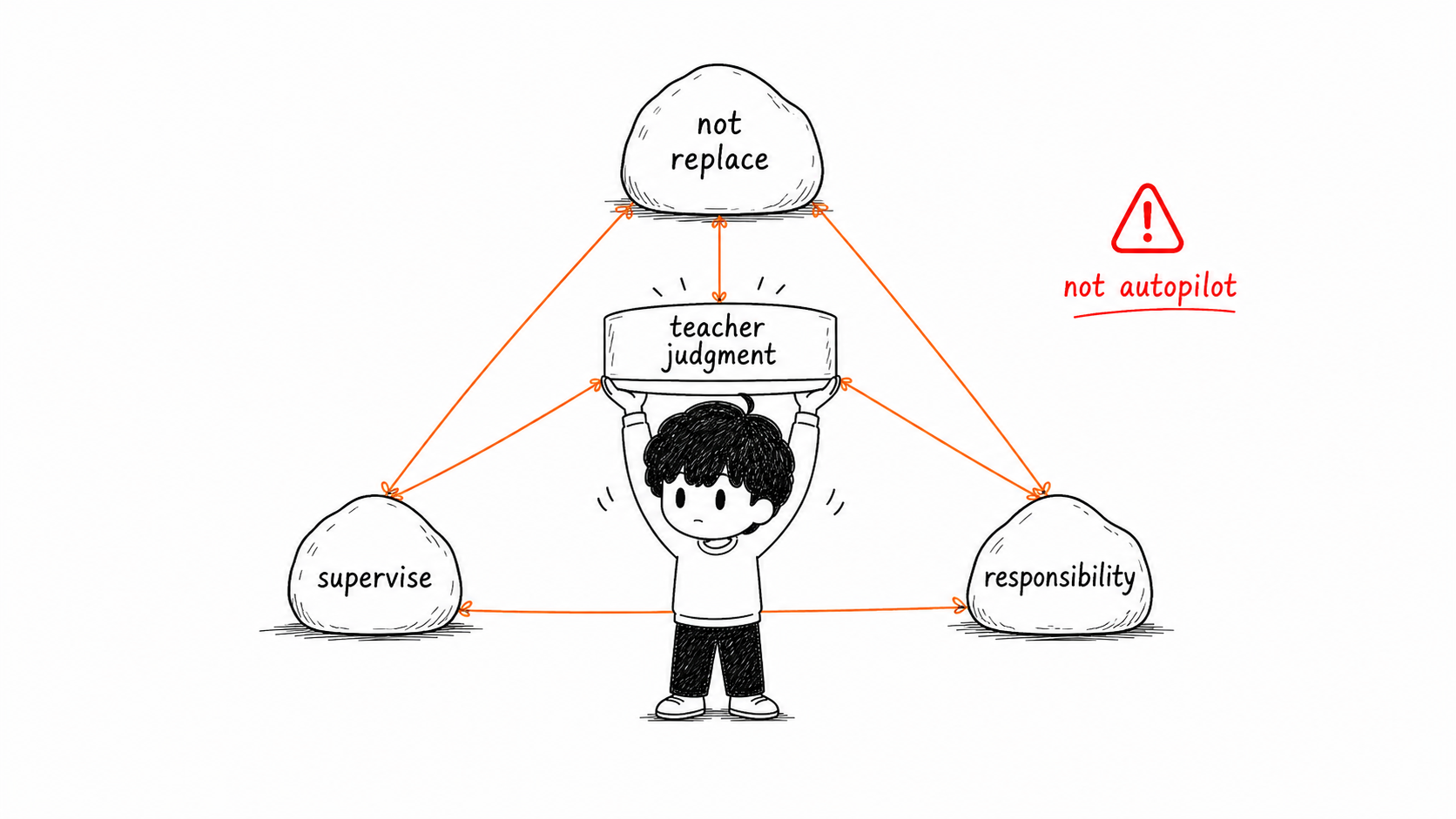
- Second, protecting teachers’ rights. AI should not replace teachers’ accountability. Teachers are not passive recipients of technology; they should lead educational change.
- Third, ensuring an inclusive digital future. The framework explicitly warns that AI may damage cultural and linguistic diversity and narrow knowledge.
- Fourth, promoting trust and environmental sustainability. This point is discussed less often, but UNESCO writes it into the core principles: the carbon emissions of AI training and operation, and their potential climate impact, are included in teachers’ AI literacy.
- Fifth, lifelong professional learning. Teacher development runs across the whole career. It is not a one-time training.
1.3 The structure: 5 aspects × 3 progression levels
This is the core architecture of the document and the part most often cited.
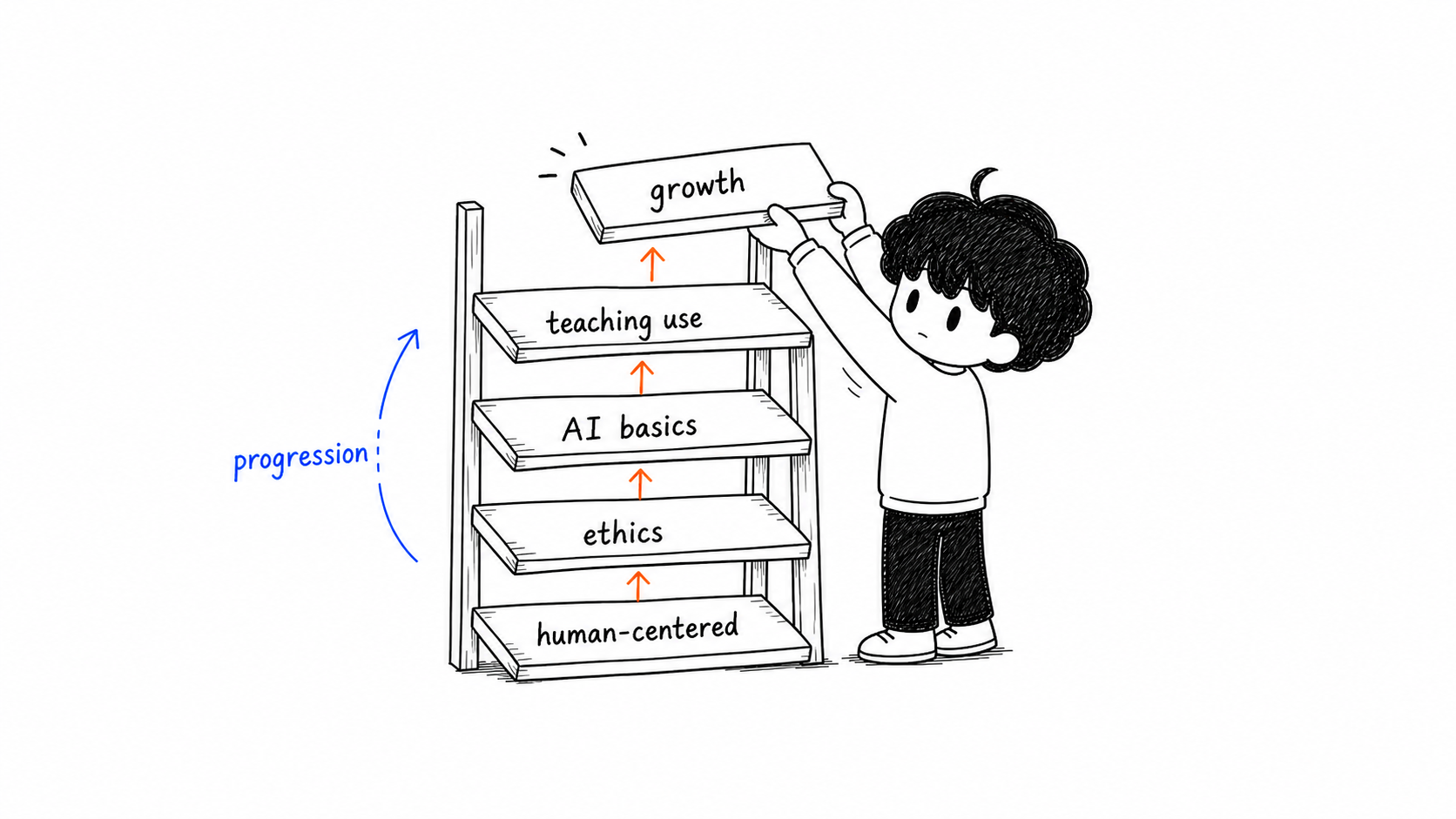
Five competency aspects: human-centered mindset, AI ethics, AI foundations and applications, AI pedagogy, and AI for teacher professional learning.
Three progression levels:
- Acquire, foundation stage: develop AI literacy, evaluate and select basic tools, and understand the basic benefits and risks of AI.
- Deepen, intermediate stage: integrate AI skillfully into teaching strategies and apply ethical rules and human accountability in practice.
- Create, advanced stage: configure AI systems to address complex educational challenges, participate in policy planning, and co-develop ethical standards.
Five aspects multiplied by three levels creates 15 competency modules. These become reference units for countries developing localized teacher AI competency standards.
1.4 What specific competencies correspond to the three levels
This part is often overlooked, but it is actually one of the most practical parts of the framework.
- At the Acquire level, teachers are expected to understand that AI is human-led, and that design decisions are influenced by corporate and individual ideologies; identify ethical issues such as privacy and inclusion; distinguish AI from traditional ICT; and use AI to support subject lesson planning.
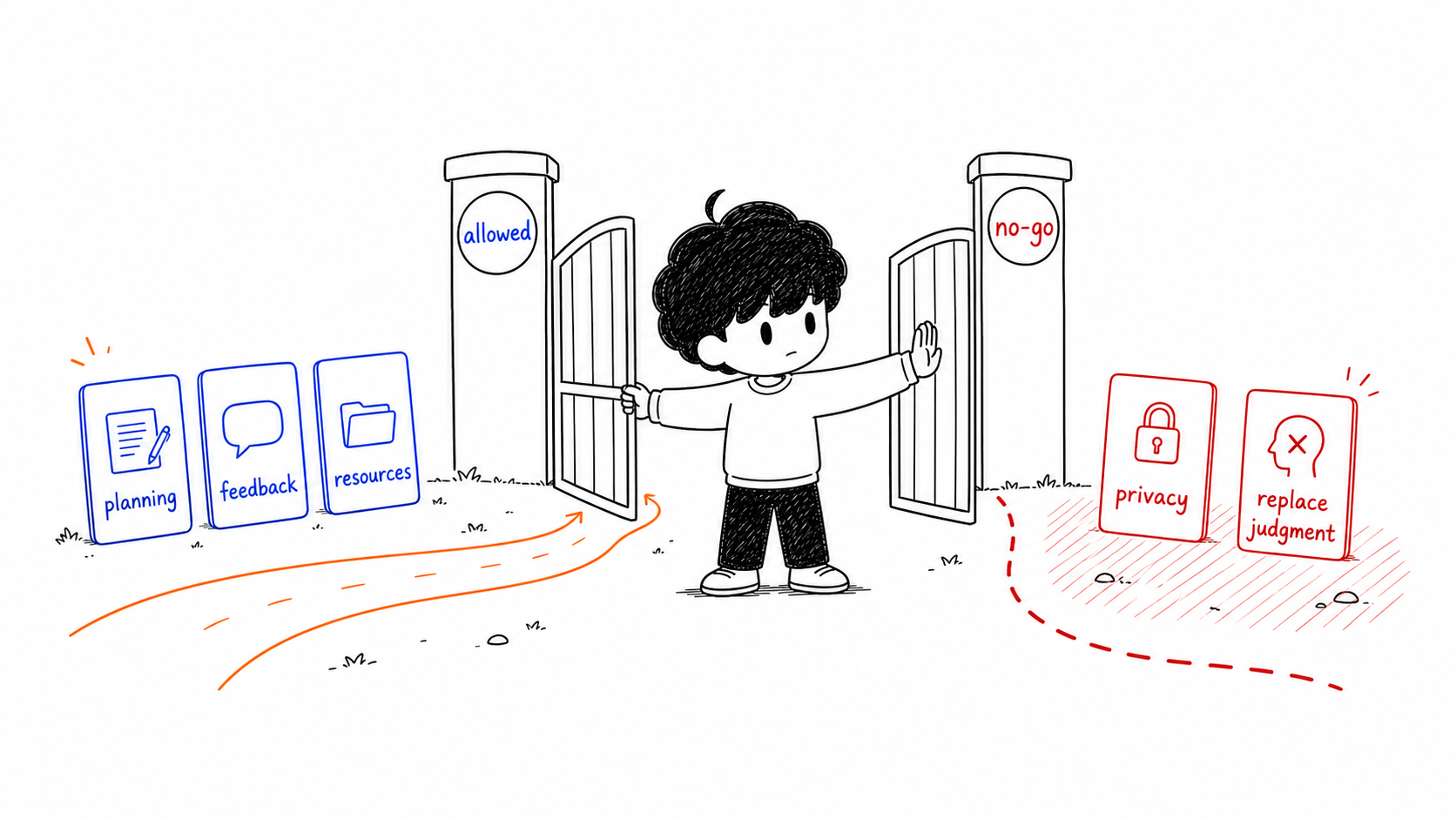
- At the Deepen level, teachers are expected to keep final human decision-making authority in key decisions; internalize privacy rules, including the GDPR concept mentioned by the framework; establish “positive lists” and “negative lists” for AI use in teaching; and use AI to support students’ higher-order thinking and emotional learning.
- At the Create level, teachers are expected to participate actively in building a fair AI society, lead discussions about ethics, modify or combine open-source AI tools to develop localized solutions, and plan AI-immersive interdisciplinary learning scenarios.
It is worth noting that these three stages are not simply a progression of tool proficiency. They are a progression of professional identity: from user, to integrator, to co-creator.
2. China’s Ministry of Education Application Guidelines: behavioral boundaries in the Chinese context
2.1 The core logic of the document
The core logic of the Guidelines is “technology empowerment, education first.” It builds a five-part framework: guiding ideology, basic principles, scenario guidance, normative guidance, and organizational support.
If the UNESCO framework describes “what competencies teachers should have,” the Guidelines answer “what teachers may do and what they must not do.” The former is a competency map; the latter is a boundary map.
2.2 Six application scenarios
The Guidelines list more than 20 detailed scenarios, grouped into six categories:
- Supporting learning transformation: dialogic and game-based learning, personalized and collaborative inquiry, interdisciplinary learning.
- Supporting teaching quality: precise learning analysis, efficient lesson plans and courseware, classroom interaction and assignment design.
- Supporting holistic education: moral education and psychology, including moral scenario libraries and psychological data analysis, plus PE, arts, and labor education.
- Supporting assessment: automated grading and diagnosis, deeper feedback, and rubric design.
- Supporting management: process optimization, including official document drafting, scheduling, parent-school communication reports, and anomaly detection.
- Supporting research innovation: teaching reflection and skill practice, plus full-process research support.
These six categories basically cover the whole workday of a teacher: lesson preparation, grading, student development, and research.
2.3 Red lines that cannot be crossed
This is the weightiest part of the Guidelines, and the part teachers most need to know.
- On teachers’ leading role in educating students: when addressing students’ ideological confusion, emotional issues, or psychological counseling, teachers must not directly adopt AI-generated content as the final plan. Teachers must lead moral education activities.
- On content review: teachers must not use AI-generated teaching designs or comments without review. Sensitive ideological content must be submitted to school administrators for review. Student comments must not become empty or formulaic. AI grading results must not be used directly as final evaluation.
- On academic integrity: core arguments and reasoning must be completed independently; AI assistance must be declared; plagiarism washing or altering others’ works is prohibited.
- On student use: independent use of generative AI by primary school students is prohibited in principle. Students must not directly submit AI-generated assignments; they must submit process materials and mark citations.
- On data security: sensitive or confidential content must not be uploaded. Before processing learning data, names, family information, and other sensitive data must be removed. Collection of non-essential personal information or audio/video recording requires explicit guardian authorization.
- On values red lines: generating or spreading content that harms national security, promotes violence or pornography, or distorts territorial sovereignty is prohibited.
2.4 Three levels of organizational support
The Guidelines also specify implementation responsibilities:
- Local education departments: formulate implementation rules, establish AI tool evaluation and access mechanisms, and include AI literacy in teacher training.
- Schools at all levels: integrate the guidelines into school-based management and establish routine monitoring of use.
- Relevant companies: implement data classification and algorithm filing, and provide professional educational technology support.
3. The 2026 China Teacher GAI Application Report: what 86,000 questionnaires reveal
3.1 Survey scale and analytical framework
This report is based on 86,000 valid questionnaires from 30 provinces across China. It uses a four-dimensional, three-level model, summarized as Dao, Fa, Shu, Qi (道、法、术、器), to deeply analyze teacher AI literacy. It is currently the largest empirical study on Chinese teachers’ AI use.
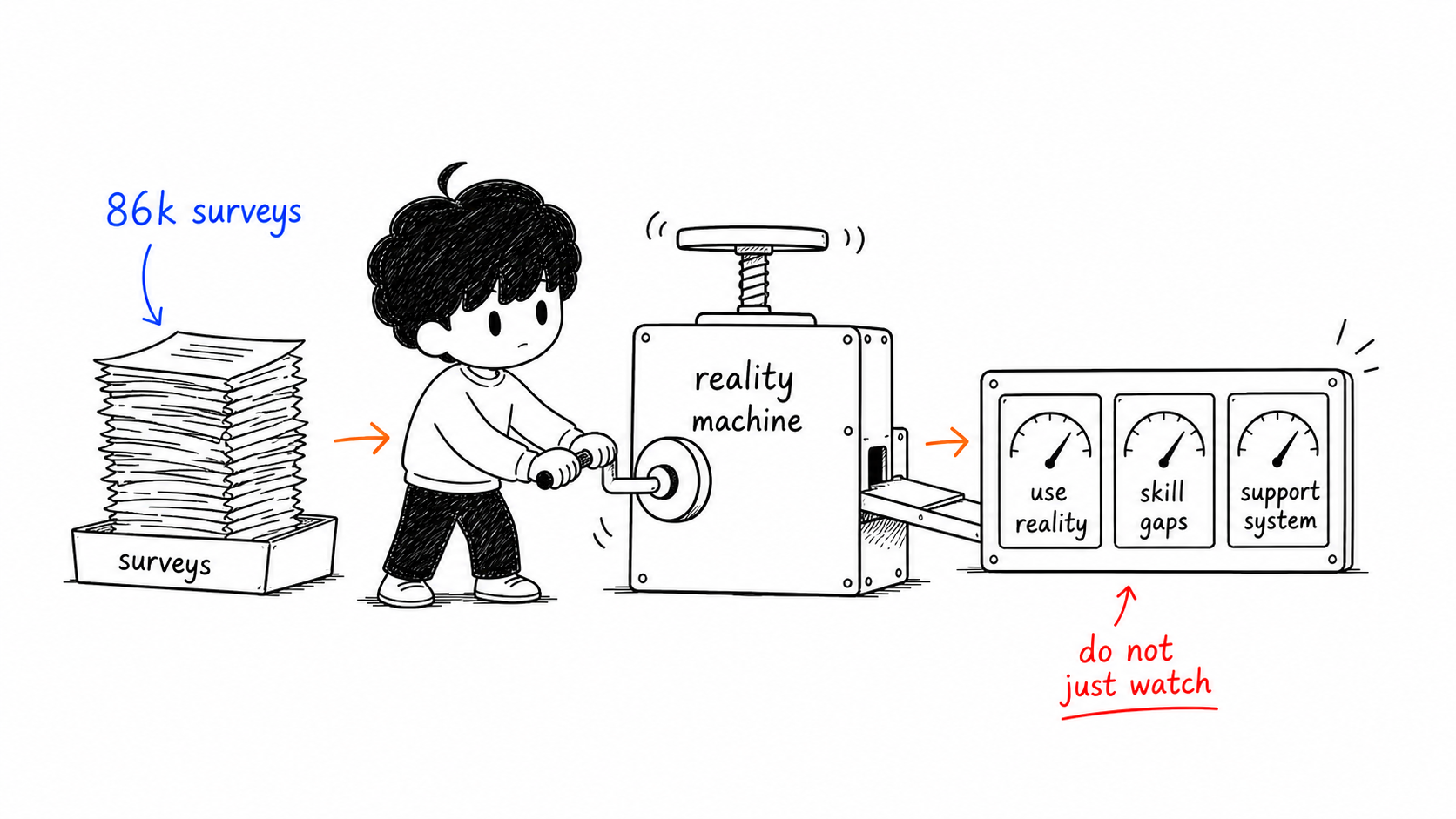
3.2 Core data on the current situation
Application penetration:
- 96.1% of teachers actively learn AI tools
- 92.3% have tried integrating AI into the classroom
- 96.9% use conversational or generative AI, ranking first
- 77.7% use the National Smart Education Platform (国家智慧教育平台)
Perception and attitude:
- 69.4% clearly perceive changes in teacher responsibilities brought by AI
- 69.1% clearly identify areas of work AI cannot replace
- Overall attitudes have shifted from doubt toward rational openness, tending to see AI as a partner that frees productivity
Core anxieties:
- 86.0% worry that students’ overdependence on AI will weaken independent thinking
- 57.2% worry that technology will weaken emotional communication between teachers and students
Barriers to application:
- 67.4% say there are no suitable resources
- 62.9% are troubled by technical instability
- 44.8% report high learning costs
3.3 The report’s “irreplaceable core values” of teachers
The report explicitly identifies four core values that teachers must hold in the AI age. This part echoes the human-centered principle in UNESCO’s framework:
- Value guidance: moving from algorithmic recommendation back to meaning-making, leading values education in moral cultivation.
- Emotional resonance: machines cannot simulate real empathy and eye contact; teachers guard students’ mental health.
- Thinking activation: guiding students from getting answers to asking high-quality questions, igniting critical thinking.
- Embracing uncertainty: improvising creatively in dynamic and complex teaching situations.
3.4 System support: foundation, guardrails, and engine
The report systematically summarizes China’s teacher AI support system as three parts:
- New digital education foundation: building educational computing services through “Eastern Data, Western Computing” (东数西算), establishing Guidelines for Educational Data Classification (《教育数据分类分级指南》), and developing controllable education-specific large models and multimodal corpora.
- Value orientation and ethical guardrails: issuing standards such as Guidelines for Teachers’ Use of Generative AI (《教师生成式人工智能应用指引》), establishing governance principles of high-level guidance plus bottom-line constraints.
- Cultivation and practice engine: using the National Smart Education Platform (国家智慧教育平台) for large-scale professional learning and connecting pre-service and in-service teacher development across the career.
3.5 The transformation pathway of teacher roles
The report describes a clear pathway for teacher role change in the AI age: traditional tool user → human-AI collaborative designer → values guardian.
This path strongly echoes UNESCO’s three-level model. “Human-AI collaborative designer” roughly corresponds to UNESCO’s Deepen stage, while “values guardian” corresponds to the more critical and leadership-oriented parts of the Create stage.
Where the three documents overlap: they say the same thing in several places
After reading all three documents, several highly consistent judgments stand out:
First, human accountability is the baseline. UNESCO states it explicitly; China’s Teacher Application Guidelines express it through “teachers must lead key educational moments”; and the Teacher GAI Report confirms it through the “irreplaceable core values” of teachers.
Second, values guidance, emotional support, and psychological counseling are protected zones. The three documents are completely aligned on this point: these parts cannot be led by AI and must be completed by teachers themselves.
Third, student use of AI needs special regulation. China’s Teacher Application Guidelines set a principled prohibition on independent AI use by primary school students. UNESCO warns that overreliance on AI may harm thinking skills. The 86% teacher anxiety in the report points in the same direction.
Fourth, teacher AI literacy is a continuous development process. All three documents reject the idea that “AI training” is a one-time event. They emphasize lifelong professional learning.
One-sentence summary
If the common position of the three documents had to be summarized in one sentence, it might be this:
AI should be deeply integrated into teachers’ work, but teachers must retain final judgment and emotional leadership over the educational process.
In the documents, this sentence is a judgment. In the classroom, it becomes a problem. In the next article, we will discuss that problem.
This article belongs to The Teacher’s Position: Three AI Documents and What Comes After (《教师的位置:三份 AI 文件,与三份文件之后》). See the series index for source, reference, and AI-use notes.