In one sentence: a teacher who knows how to ask AI is like a conductor leading an orchestra. Not every musician is perfect, but the music they make together can be powerful.
😅 Have you experienced these moments?
- You ask AI, “Help me design a Chinese lesson plan,” and receive something vague and generic.
- You ask AI to generate math problems, and it gives you a problem beyond the curriculum that no one in class can solve.
- You want a homeroom advisory activity, and AI gives you a motivational lecture that makes students sleepy.
The problem is not AI itself. It is how we ask. You cannot say to an intern, “Go handle that project,” without explaining what needs to be done, why it matters, and what standard it should meet.
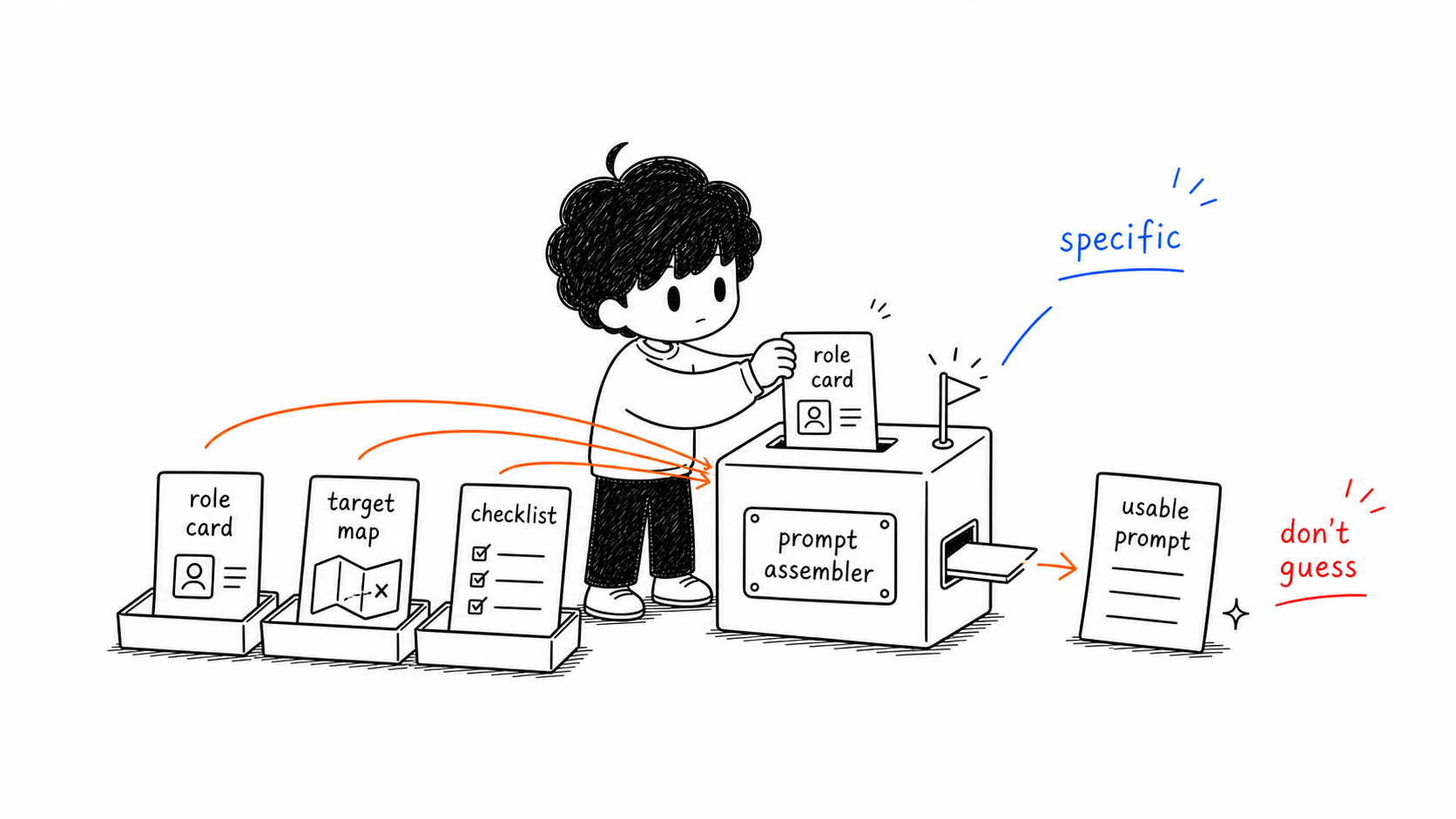
🎯 The three-step prompting method: make AI your teaching confidant
Step 1: Give AI an “identity card” (role setting)
Do not say: “Please design a lesson plan.”
Say: “You are a veteran middle school Chinese teacher with 10 years of experience, skilled at using real-life situations to spark student interest…”
Why it works: AI draws on different patterns depending on the role. A specific identity works like a script for an actor: the performance becomes more precise.
Step 2: Draw a “goal map” (task description)
Do not say: “Design a homeroom activity.”
Say: “Design a 40-minute advisory lesson for seventh graders to understand the meaning of responsibility through real school scenarios and discussion, cultivating a sense of responsibility…”
Why it works: clear task boundaries keep AI from drifting. It is like giving an intern a detailed work brief instead of saying, “Do something useful.”
Step 3: Provide a “quality checklist” (specific requirements)
Do not say: “Make it suitable for middle school students.”
Say: “Use clear and accessible language, avoid abstract concepts, use real examples from campus life, keep each activity within eight minutes, and end with a short but powerful guiding question…”
Why it works: specific standards help AI meet expectations. It is like telling an intern, “This report needs three data charts, fewer than 2,000 words, and is due Friday.”
🌟 Middle school teaching cases: from failure to delight
Case 1: Chinese language teaching, Zhu Ziqing’s Spring (《春》)
Failed prompt: “Help me design an activity for Spring.”
Result: generic reading aloud, paragraph division, and theme summary, with nothing new.
Better prompt:
“You are a veteran middle school Chinese teacher with 15 years of experience, especially good at using sensory experience to help students understand the beauty of prose. Please design a 20-minute classroom segment for seventh graders on Spring (《春》), focusing on aesthetic appreciation. Requirements: 1) begin with the ‘spring wind’ paragraph; 2) design an eyes-closed imagination activity about spring wind brushing the face; 3) guide students to notice how the author expresses emotion through tactile description; 4) provide 2-3 open-ended questions; 5) use language that is beautiful but easy to understand.”
Effect: AI generated a complete teaching chain of sensory activation, close reading, and aesthetic transfer, including teacher language and transitions.
Case 2: Mathematics, geometry proof
Failed prompt: “Make a geometry problem.”
Result: a problem that was too difficult, with a complex figure and a mismatch with teaching progress.
Better prompt:
“You are a middle school mathematics teaching and research group leader, expert in geometry teaching and in designing problems that build logical thinking. Please design one geometry proof problem for eighth graders on congruent triangle criteria. Requirements: 1) moderate difficulty, suitable for a 10-minute classroom exercise; 2) simple figure that can be drawn on the board; 3) use the SAS criterion; 4) include one common misconception about corresponding sides; 5) provide detailed solution steps and teaching tips.”
Effect: AI generated a problem aligned with student readiness and teaching value, predicted possible student errors, and offered teaching strategies.
Case 3: Moral education, class management
Failed prompt: “Help me write a class agreement.”
Result: empty slogans such as “be honest” and “follow discipline,” which students forget immediately.
Better prompt:
“You are an excellent homeroom teacher with 10 years of experience, skilled at cultivating rule awareness through democratic participation. Please design an activity for seventh graders to create a class agreement. Requirements: 1) 40-minute advisory lesson; 2) include 4-5 core rule areas such as classroom discipline and peer relationships; 3) design a process of group discussion and whole-class voting; 4) provide teacher facilitation language; 5) generate a concise and visually clean agreement template; 6) reflect mutual respect and fit adolescent psychology.”
Effect: AI generated an actionable activity flow with language, timing, and materials, ready to use.
💡 Advanced techniques: from asking well to becoming skillful
- Upload teaching materials so AI understands you better
Many AI tools support file uploads:
- Upload textbook chapters so AI generates activities based on specific content
- Upload student characteristics, such as “my class has 25 students; they are lively but easily distracted”
- Upload previous excellent lesson plans so AI learns your teaching style
Example:
“I uploaded the seventh-grade Morality and Law (《道德与法治》) unit on ‘being honest,’ as well as a class profile: students are lively but easily distracted. Please design a 40-minute interactive activity based on this, focusing on helping students understand how honesty appears in daily life.”
- “Talk” with AI and iterate
Do not expect perfection in one round:
- First round: get a basic structure
- Second round: “This design is good, but can you add a small-group sharing stage?”
- Third round: “Can the language be adjusted to better fit seventh-grade comprehension?”
- Save effective prompts and build your own prompt library
Record the prompts that work:
- By subject: Chinese, mathematics, English, moral education
- By task type: lesson planning, advisory, parent communication, assignment design
- Revise continuously and develop your own style
⚠️ Safety boundaries: some things AI cannot replace
In frontline teaching, no matter how technology develops, some things must be done by teachers themselves:
🚫 Irreplaceable parts of education
- Value guidance: AI does not understand what responsibility, honesty, and respect truly mean
- Emotional development: students need real teacher-student emotional connection
- Thinking development: higher-order thinking needs cognitive conflict designed by teachers
- Individual care: each student’s growth rhythm requires teacher observation
✅ AI’s best role
- Preparing materials: generate a draft, then you improve it
- Offering perspectives: show different approaches, then you choose
- Saving time: handle mechanical work, while you focus on creation
- Expanding resources: recommend related materials, while you integrate them
🚀 Start today: three small actions
- Try once: choose a simple task, such as designing a lesson opening, and use the three-step method.
- Record the result: write down effective and ineffective prompts, then analyze why.
- Share experience: bring your “AI teaching prompts” to your teaching group and learn from each other.
Remember: a teacher who asks AI well is not being lazy. They are upgrading. Just as a photographer uses a camera not to replace their eyes, but to record the beauty their eyes see.
This article belongs to Generative AI Handbook for Frontline Teachers (《一线教师的生成式AI手册》). See the series index for source, reference, and AI-use notes.