In one sentence: guidance is better than prohibition, and understanding is better than fear. Teaching students to dance with AI is a required course for teachers in the digital age.
🤔 A real dilemma
Last Tuesday, Ms. Zhang found a “perfect” essay in writing class: elegant language, rigorous structure, and deep ideas. But when she asked the student, Xiao Li, “Which sentence in the essay do you like best?” he could not answer.
Later, Xiao Li admitted: “I used AI to write the first draft, then changed it a little.”
Ms. Zhang faced a choice:
- Criticize him seriously and ban AI?
- Pretend she did not notice?
- Or turn it into an educational opportunity?
In fact, we chose the third path.
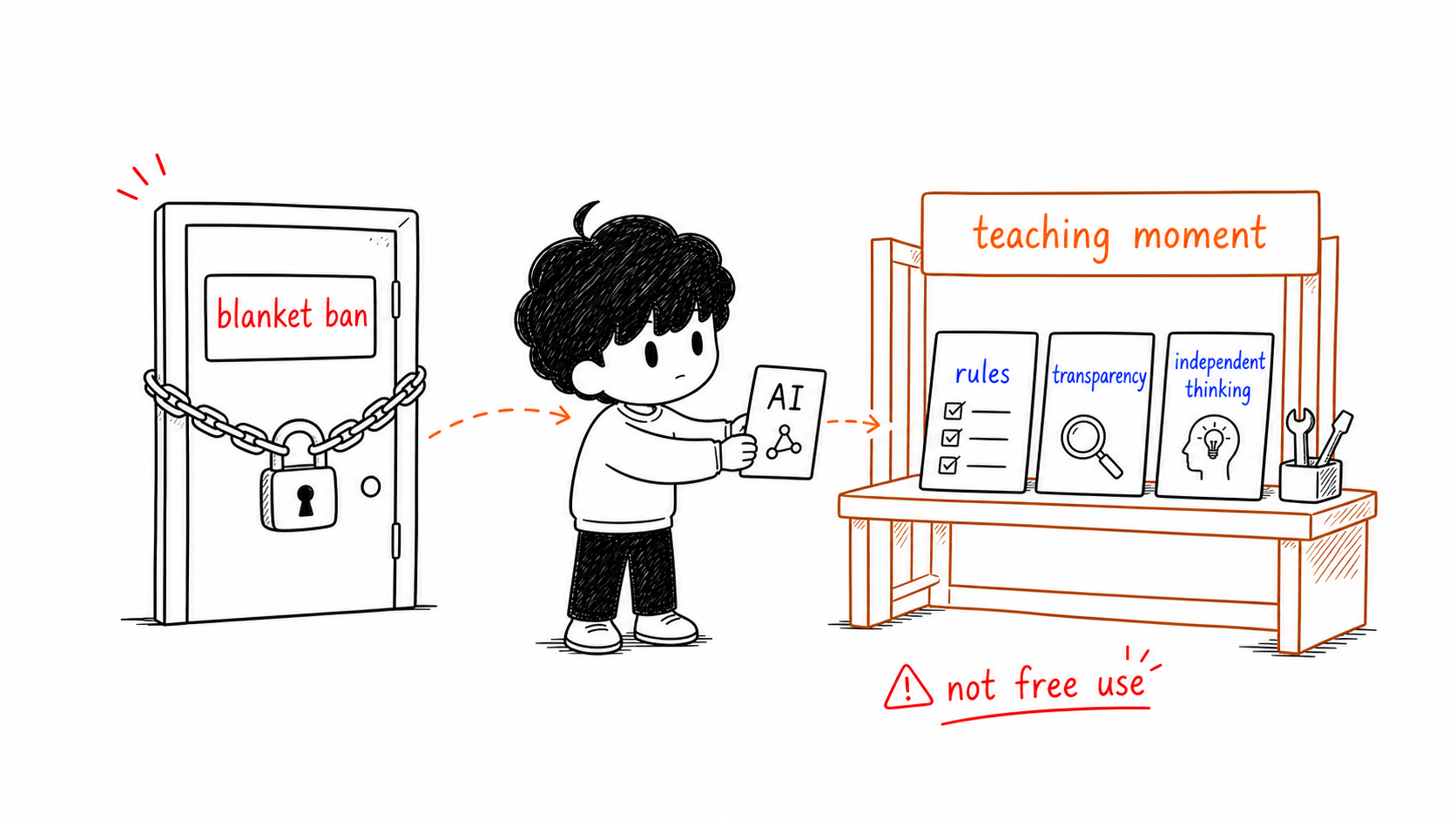
💡 Why a blanket ban is the weaker option
A 2025 China Youth Daily (中国青年报) survey reported that 99.2% of surveyed students were using AI. Among them, 11.7% were “heavy users” who used AI many times almost every day, and 65.9% said they instinctively turned to AI first when facing a problem.
The consequences of banning:
- Students move AI use underground, and teachers lose the chance to guide them
- Students lack judgment and may be misled by false information
- Schools miss a key moment for cultivating digital literacy
- Trust between school and families may crack
The better posture is to guide responsible use. It is like teaching children to use a knife: we do not hide it; we teach safe use.
📜 Classroom AI Use Agreement
Preface: As frontline teachers, we believe technology is a tool and human development is the purpose. This agreement is not meant to restrict students, but to help everyone use AI to improve learning while protecting the ability to think independently, which is the core value of education.
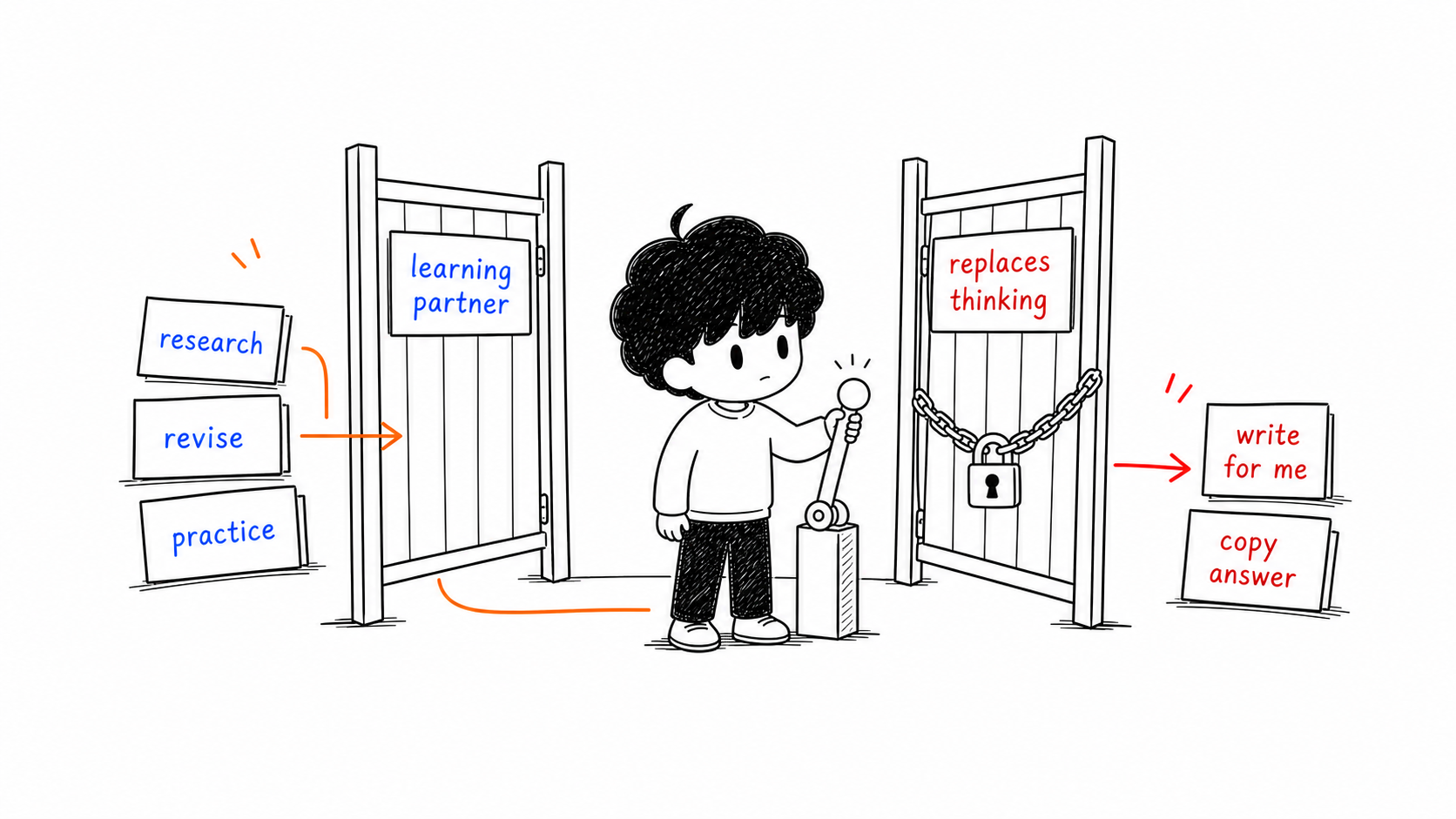
✅ Allowed: AI as a learning partner
| Scenario | Responsible use | Why allowed |
| Knowledge exploration | Use AI to find background information and explain unfamiliar concepts | Quickly access information and expand knowledge |
| Language improvement | Use AI to check grammar, punctuation, and unclear sentences | Improve accuracy of expression |
| Thinking expansion | When stuck, use AI to offer different perspectives | Break fixed thinking and spark creativity |
| Creative inspiration | Use AI for inspiration in the early stage of art or project design | Stimulate creativity and reduce blank-page anxiety |
🚫 Strictly prohibited: thinking AI cannot replace
| Action | Why prohibited | Alternative |
| Submitting a complete AI-generated assignment directly | It weakens independent thinking and violates the nature of learning | Use AI for inspiration, then organize the work yourself |
| Accepting AI-provided facts without verification | AI can produce confident nonsense | Verify with at least two authoritative sources |
| Revealing personal or classmates' private information to AI | Creates data security risks and possible misuse | Use pseudonyms and avoid specific details |
| Relying on AI to make decisions or judgments | Weakens critical thinking and decision-making ability | Use AI to provide options, then make the final judgment yourself |
🔍 Transparency principle: all AI assistance must be marked
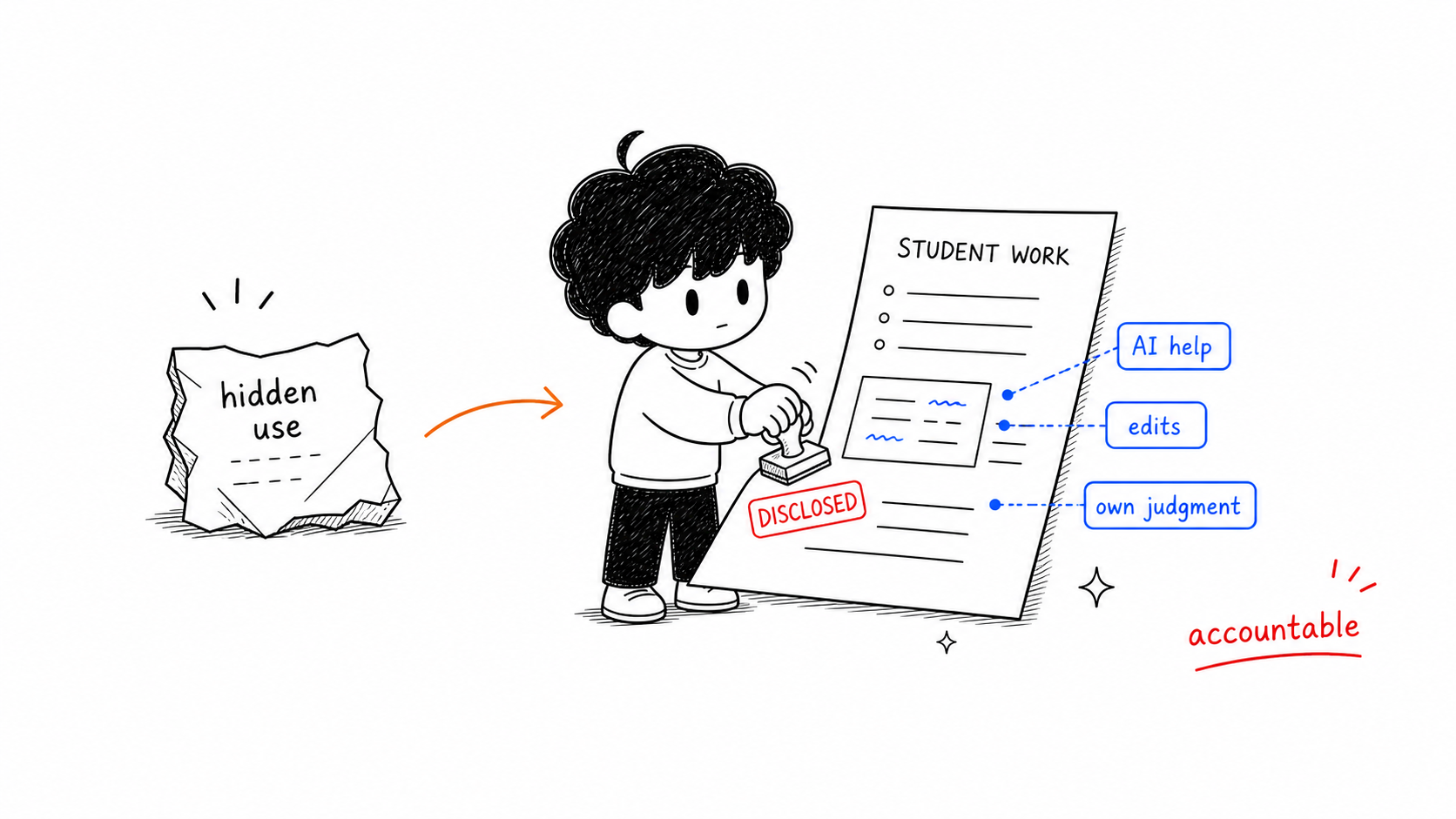
Assignment annotation template:
In this assignment, I used [AI tool] for the following support:
1. Looked up the scientific principle of photosynthesis
2. Checked grammar errors in my English essay
3. Got suggestions for experimental design
I confirm that the core thinking, viewpoint expression, and data collection are my own work.
Student signature: __________
🎯 Implementation guide: how to put the agreement into practice
- Agreement creation: let students participate instead of passively accepting rules
Activity design:
- Preliminary survey: use an anonymous questionnaire to understand student AI use
- Values discussion: discuss “the value of thinking” in advisory by comparing solving a problem independently and using AI
- Co-creation: group discussion of agreement clauses, followed by whole-class voting
- Signing ceremony: formally sign the agreement to build ritual and responsibility
Real case: When one class created its agreement, students proposed adding a rule that AI must not be used to generate evaluations of classmates. This showed collective wisdom.
- Daily guidance: not surveillance, but support
Practical tools:
- AI use record sheet: briefly record purpose, tool name, and support stage
- Peer review: group members check whether AI use has been marked reasonably
- Random explanation: ask students to explain key thinking in their work
- Responding to violations: education first, punishment second
Tiered response:
- Minor violation, such as forgetting to mark AI use: oral reminder and resubmitted annotation
- General violation, such as overdependence: redo the assignment and write a 300-word reflection
- Serious violation, such as academic misconduct: parent meeting and improvement plan
👨👩👧 Parent communication: from anxiety to alliance
Common parent worries:
- “Will my child become dependent on AI and stop thinking?”
- “Will AI teach my child bad things?”
- “Is privacy safe?”
Effective communication strategies:
- Parent meeting topic: use data and cases
Key points:
- Share anonymous class survey data on AI use
- Share real cases of responsible AI use improving efficiency
- Demonstrate the Classroom AI Use Agreement and guidance mechanisms
- Introduce practical family supervision tips
- Simple family guidance
Three sentences for parents:
“Pay attention to what your child uses AI for, not only whether they use it.” “Asking ‘Did you think about this first?’ is more effective than ‘Did you use AI?’” “Use AI together with your child so you understand its abilities and limits.”
Practical tips:
- Three-question method: ask “Did you think first?” “What advice did AI give?” “Why did you choose this approach?”
- Process check: ask to see drafts and thinking notes, not only the final answer
- Shared experience: use AI together on a small weekend project
- Individual communication language
When a parent worries:
“Xiao Ming’s mother, I understand your concern. At our school, we are not banning technology. We are teaching children how to use it responsibly. Just like search engines, we do not ban them; we teach children to judge information. AI is the same. Last week, Xiao Ming solved a math problem by himself first, then used AI to check his reasoning. That kind of use is encouraged. I suggest trying the principle of ‘think first, assist later’ at home as well.”
💡 Practical toolkit for teachers
- Classroom activities
- “AI detective” game: give students three assignments, fully human, partially AI-assisted, and fully AI-generated, and ask them to identify differences
- “The value of thinking” comparison: compare the process of writing an essay yourself with an AI-generated essay, then discuss the difference
- “Bias magnifier”: analyze potential bias in AI-generated content to build critical thinking
- Recommended resources
- Day of AI: AI literacy curriculum from preschool to high school (Day of AI《学前教育至高中全阶段AI启蒙课程》)
- AI foundations course for Grades 6-12 (6-12年级人工智能基础课程)
- ISTE K12 AI curriculum framework (国际教育技术协会(ISTE)《K12人工智能专项课程体系》)
- Emergency response
When you discover inappropriate AI use:
- Stay calm: do not criticize publicly; talk privately
- Understand the reason: “Why did you choose to use AI for this assignment?”
- Guide educationally: explain the value of the thinking process
- Repair: redo the work and add a reflection
- Follow up: observe improvement and give encouragement
🌟 Ultimate goal: cultivate thinkers in the AI age
As educators, our goal is not to cultivate students who never use AI. It is to cultivate thinkers who can dance with AI. They:
✅ Can judge whether information is true or false, and do not blindly follow any source, including AI
✅ Can use tools to improve efficiency without letting tools replace thinking
✅ Can critically evaluate technological influence in multicultural contexts
✅ Can maintain independent character and human care in the digital world
This is what we expect from education: a solid foundation in the national curriculum and a broad international perspective; respect for traditional educational values and openness to technological innovation.
🚀 Start today
- Choose one class and pilot this agreement.
- Design one advisory lesson about AI and thinking.
- Prepare a parent letter explaining your class principles for AI use.
Educational wisdom is not about what we prohibit. It is about what we guide. In the AI wave, let us be the ones holding the helm.
This article belongs to Generative AI Handbook for Frontline Teachers (《一线教师的生成式AI手册》). See the series index for source, reference, and AI-use notes.